Ines Peters · 12 September 2026
Ancient Forging Logs Digitized to Shape Emission Cuts in Contemporary Metallurgy
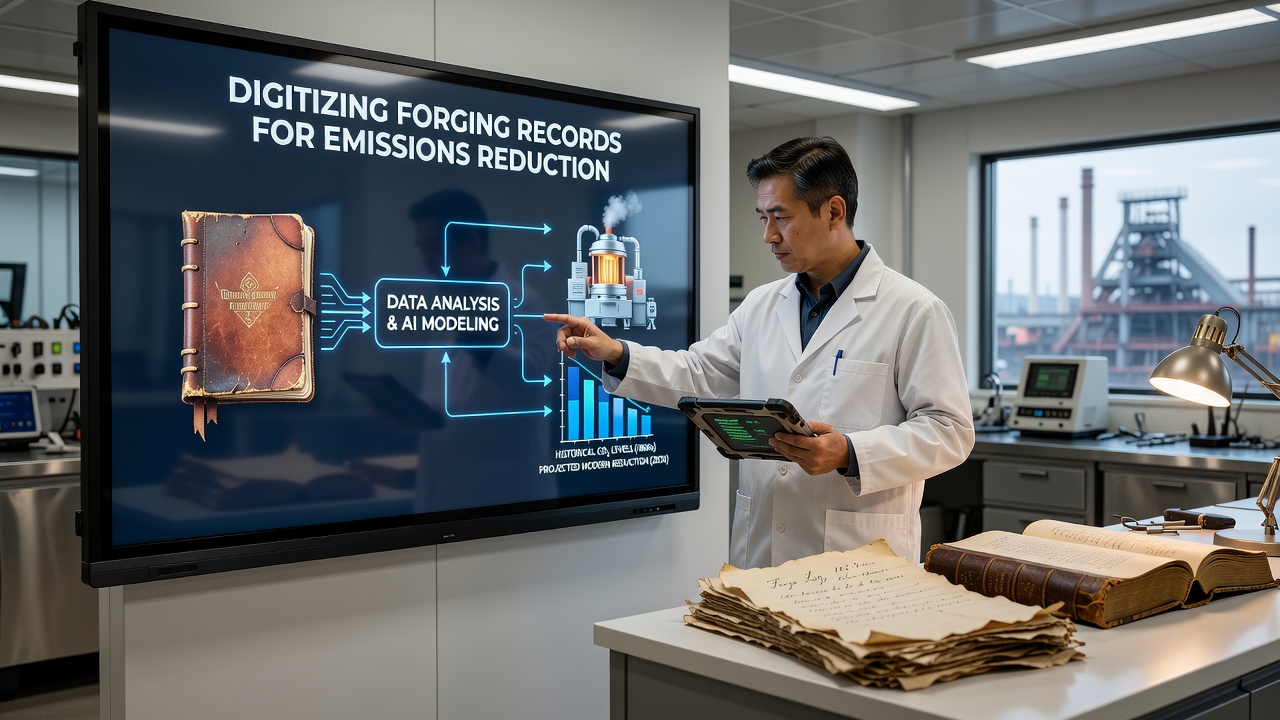
Metallurgy has long relied on heat-intensive processes that generate substantial carbon outputs, yet teams across research institutions now turn to preserved records from earlier centuries to identify lower-impact approaches. These documents detail forging temperatures, fuel selections, and cooling sequences that operators once tracked by hand, and digitization converts them into searchable datasets for comparison against current production metrics. Projects in multiple countries have already begun this conversion, pulling from European monastery archives and Asian trade ledgers that stretch back to the 1500s.
Emissions Pressures in Steel and Alloy Production
Steel manufacturing alone accounts for roughly 7 to 9 percent of global carbon dioxide releases according to figures compiled by the International Energy Agency, while aluminum and specialty alloy lines add further loads through their reliance on electric arc furnaces and chemical reduction steps. Regulatory frameworks in the European Union require facilities to report and progressively lower these outputs under the Emissions Trading System, whereas Canadian federal guidelines push similar reporting through the Greenhouse Gas Pollution Pricing Act. Researchers note that traditional methods sometimes operated at narrower temperature bands or used charcoal blends that produced different gas profiles than modern coke-based routes, and these variations become quantifiable once the old logs enter structured databases.
Conversion of Paper Archives into Usable Data
Teams employ optical character recognition combined with machine-learning models trained on period-specific handwriting to extract entries on bloom sizes, hammer sequences, and slag compositions. One initiative completed initial scans of 12,000 pages from Polish and Swedish collections by mid-2025, then cross-referenced the extracted values against modern thermocouple readings to estimate energy requirements per kilogram of finished bar. The resulting models reveal that certain 18th-century Swedish hearths maintained consistent output with fuel inputs 15 to 20 percent below equivalent contemporary batches when normalized for final product strength. Such comparisons rely on statistical matching rather than direct replication, since raw material chemistries have shifted over time.

Integration with Present-Day Reduction Planning
Once digitized, the records feed into simulation software that tests hybrid process designs, such as pre-heating billets with recovered waste heat in patterns observed in older Italian workshops. Plant engineers in Germany have already adjusted one rolling line to incorporate staged cooling intervals drawn from 17th-century entries, cutting natural gas consumption by 8 percent during trials reported in 2025. Data from the Australian Department of Climate Change, Energy, the Environment and Water indicate that similar incremental changes scaled across the sector could contribute measurable portions of national reduction targets by 2030. Observers point out that the historical datasets also flag seasonal variations in charcoal moisture that affected combustion efficiency, information now used to refine moisture sensors on modern biomass injectors.
Project Milestones Scheduled for September 2026
A multi-institution consortium plans to release a public portal in September 2026 that merges the digitized forging archives with real-time sensor feeds from participating mills. The platform will allow users to query historical parameter sets against specific alloy grades and receive suggested adjustments ranked by projected emission savings. Early beta tests completed in 2025 showed that operators could identify viable temperature reductions in 40 percent of queried cases without compromising tensile strength targets. Funding for the final integration phase comes from national research councils in Poland, Sweden, and Canada, with additional support routed through the European Research Council.
Challenges in Data Interpretation and Validation
Accuracy remains a concern because many original logs lack calibration details or consistent units, requiring historians and materials scientists to reconstruct measurement contexts through cross-referencing with surviving physical artifacts. Discrepancies appear when charcoal carbon content estimates from 1600s records differ from laboratory assays of preserved samples, prompting ongoing refinement of conversion algorithms. Despite these hurdles, validation runs at pilot facilities demonstrate that suggested parameter shifts derived from the archives produce emission profiles within 5 percent of modeled values when implemented under controlled conditions.
Conclusion
Digitization of centuries-old forging records supplies quantitative references that modern metallurgy teams apply to emission modeling and process tweaks. Continued expansion of these datasets, paired with regulatory reporting requirements in multiple regions, positions historical evidence as one practical input among several for reaching sector-wide reduction goals. The September 2026 portal release will expand access, allowing broader testing of archive-informed strategies across additional facilities.